
NaN

Over Sharing
This is the third in a series of 3 blogs responding to research from residency @ Battersea Arts Centre March 2026 + Climate Grief Café @ Dugdale Arts Centre to create new project(s) exploring ecology and ancient grieving practices, work funded by Arts Council England and National Lottery.
New Project Blog Series, 3: Over Sharing - What constitutes a healthy space for sharing works in progress?
In preparing to share new work at Theatre Deli as part of new phase of development, in this blog I am reflecting on my experiences of sharing work in process, the wider culture of doing this and lessons from my experiences of sharing in various contexts.
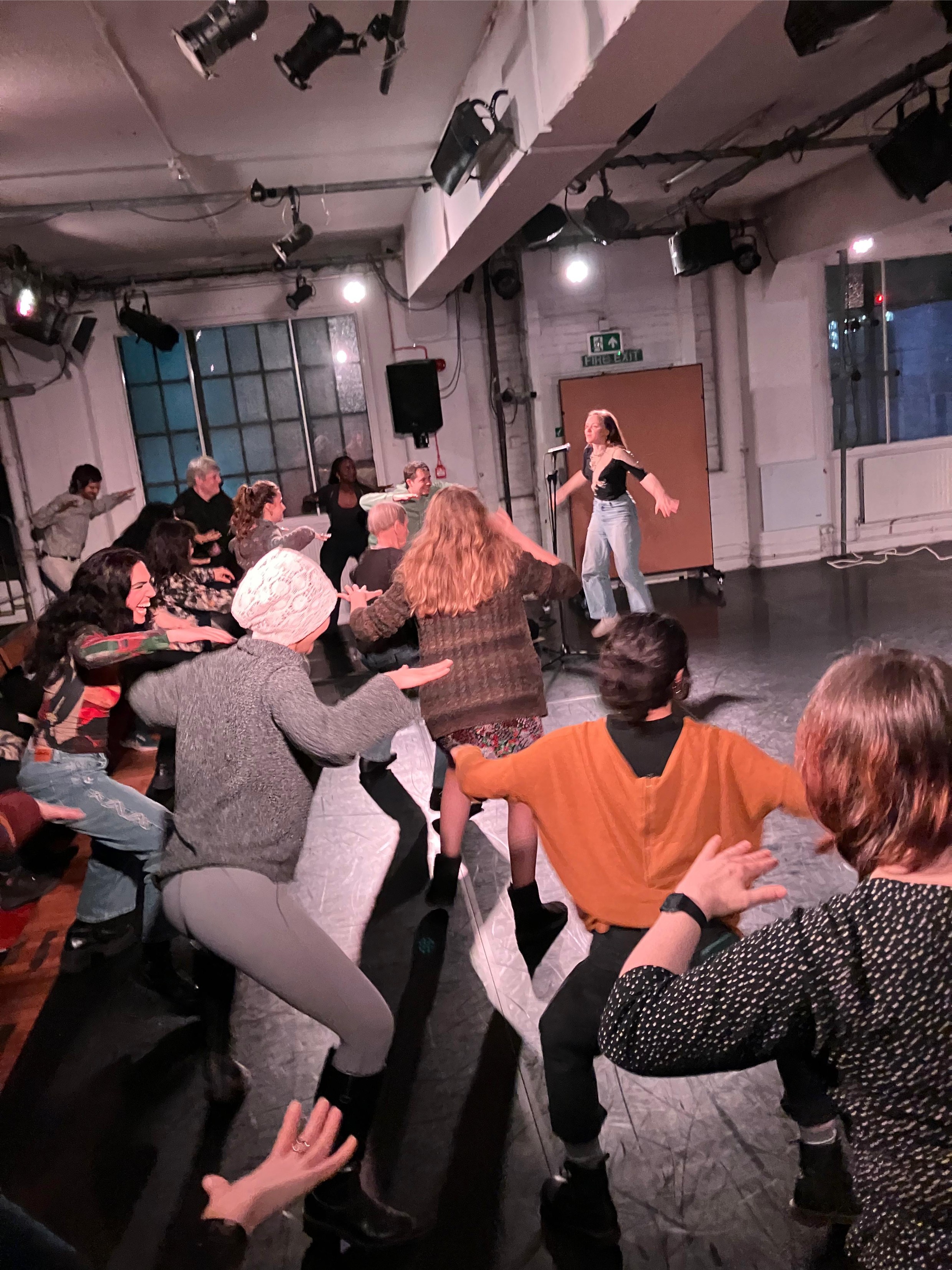
What is a sharing? Or a ‘work in progress’? I am talking about this in the context of live work that might be called performance, live art, new work, theatre, or all of the above. In my definition, a ‘sharing’ in this context is: an activity where artists informally ‘share’ in process, unfinished work with people to gain further insights into whatever it is they are exploring. This word, ‘share’ lowers risks and expectations, it signifies informality and allows people to come to something knowing they are seeing pieces of a jigsaw puzzle that haven’t been put together yet. When people come to a sharing hopefully a process of discovery will take place for the artist to further understand how people are witnessing and meeting their work.
It can take place in private/invite only settings or in public settings where the context around the performance clearly sign posts it as something that is in progress and ‘unfinished’. It can take place in a rehearsal room, traditional performance space or in any setting relevant to the artists work (site specific or otherwise). Perhaps there will be a feeling of informality surrounding the event, including activities such as a discussion post sharing, drinks and snacks.
I was not aware of the word ‘sharing’ or ‘work in progress’ until becoming an artist. Soon I understood this activity as a bedrock of performance practice which went hand in hand with the reality of making work. My first experiences of sharing unfinished and developing work was peer to peer, DIY and mostly amongst nearest, dearest pals. I still find this to be the most honest, raw way for artists to share with one another, to try and get better and create work they feel is valuable. The experience of sharing, warts and all, all the ugly things, the failures, the growing points, the not knowing why something feels important but I want to share it anyway and the flashes of brilliance.
Later down the line in my experience as an artist, sharing came with ulterior motives in professional settings outside of close knit ‘family’ peer group with gatekeepers eyes on them. These I discovered to be places full of professional risk. Sharing work that might feel vulnerable in the name of creatively exploring it isn’t necessarily kept safe in these scenarios, despite the welcoming and open language of arts spaces and professionals. I am now very wary of sharing in situations where this is demanded by anyone but the artist themselves. A forced sharing to prove something was produced, something was obtained from the artists labour and that something valuable happened. I find the alchemy of artistic process is rarely ever as straight forward as this, if its not ok to fail then how can you ever expect to create something of worth?
Why do artists share? When do artists share? What are the pressures artists may face around sharing work before it is ‘finished’? In my experience in the culture of professionalised performance practice there is a number of functions in sharing unfinished work with a live audience and why it can be invaluable to the process of creating work:
It brings an artist live response from an audience, intrinsic to artists creating work for live audience/people. The people who come to witness the unfinished work can in the very act and atmosphere of their presence charge the space, change the feeling of what an artist has created through live witnessing and let the artist in on their experience of their work. It can be important to gain this live insight at a process stage of developing work so that, if relevant, the audiences witnessing experience/feedback/thoughts/views/atmosphere can influence and the creation process of the performance or project.
It can build community and a sense of momentum, as well as reality around a developing work. People often come or are invited as active artists, makers and producers who already share a common goal or interest. It can be a place for other artists to meet each other that goes beyond the sharing of the work of the artist involved.
It can be a place where an artist can take risks without fear of failure or expectations, which can further the development of their process and work.
It can be a way of gaining invaluable feedback, verbal, written or felt, without having to formally involve professional dramaturges/artist. It is a place where your mum can offer as valuable insights as an artist with 20 years experience.
It can be a way of developing a relationship with host, venue, producing body, theatre, arts space etc in a way that is low risk to both the artist and the host. A way of trying/testing how it felt for both parties, how did the relationship feel? What did the artists audience bring to the space? Could there be a future for that relationship?
It can help the artist know if they are invested in an idea for the long haul. It can give an indication of how invested an artist is in their own work without committing to finishing a project.
To share unfinished work is important, it changes the alchemy of a process, it can be incredibly valuable. However, it can also hold risks. In my experience, here are some common pitfalls of conducting sharing of work:
Time Use: I have had experience where sharing something as an artist has felt like it wasted time in a process. For artists who have limited time in spaces (should this be the kind of thing that’s relevant to them/they need) or where space and time is a precious resource to be used wisely, portioning time aside to think about how to share what your doing with people, to work out how something will be technically shared can be time consuming. Rehearsing and preparing is not the same as developing. Trying to force material discovered in a process into a nice neat thing to share with an audience can be extremely counter productive. Will sharing help deepen or discover something? Will the act of it being witnessed feel useful and energy giving? If the answer is yes to these questions, then go for it. If not, perhaps it is not a good use of energy to share yet. If the wish to share something comes with ulterior motives to gain opportunities, make professional connections or because an artist feels pressure to share what they are doing this can be unhelpful. In my experience unless there is a way sharing work will further and fuel creative process, it can be futile and potentially backfire.
Am I Allowed to Fail?: I believe a sharing space should be a genuinely fearless space without jeopardy of professional failure to be able to develop work in a brave, creative and supportive atmosphere. Ask yourself, if opening to professional eyes beyond immediate peer circle, will sharing work be kept safe with these eyes on it? Will I feel like I can fail, that I am allowed to fail? Do I have the capacity to fail? Only the artist can know if professional risk is something they are willing to take in the process of sharing unfinished work and if this will be useful to their process.
Forcing Results: I feel like there can be a temptation for artists and arts leaders alike in a live medium to share their unfinished work in a hope to make it ‘real’. Photographs have been taken, people were there, discussions were had. It can encourage a way of thinking that’s too precious, a wish to arrive at a finished idea frozen in time. Or maybe that’s just me? I try to ask myself, why is now a good time to bring things together? Does this feel natural or am I forcing it? How does sharing something serve a process rather than a product?
So after considering what sharing culture is, its advantages and pitfalls, this is my golden list of what I believe is helpful when sharing unfinished work:
* Food, snacks and drinks! I love the social side of sharing developing work and how this can feed into a wider sense of community practice. As third spaces disappear, lets make the most of this one. I want to make the process of sharing work enjoyable for the artist and people who attend. If possible serve drinks, tea, coffee, food, foster social as well as artistic conversation, it can help bring joy!
* Let Me Fail: If you feel the pressure to share something that feels slick, perhaps even a semi 'audition' piece, will this help you to find out anything about your work which is valuable? Who will this serve and why? Resist expectations from yourself or others to share. If you feel uncomfortable to share work outside of immediate peer circle (to gatekeepers/high up art people), ask yourself, is being uncomfortable worth it? Will it serve the creation of the work I want to make?
*There should never be expectations to share of artists from arts leaders/artistic hosts. Artists should develop and spend time in ways that are valuable to them, this wont necessarily be on working towards producing 'productive' work at that moment in time, but perhaps other activities that are strengthening their work and process in other ways.
* Work as currency: If sharing for professional opportunities, see your developing work as a valuable currency, don’t spend it in situations where you won’t be valued or respected for the time and effort that has been put in.
* At what stage: Don’t rush the process of sharing your work with people, it will be ready in its own time for when it feels useful to share. This will be different for every artist and project.
* Ask: Why is it helpful to your work to share it? What do you seek to discover in the act of doing this? Why is it important for the people you invite to come? What will they bring?
*Joy: It’s difficult to create work, if seeking to share part of the journey with people, ask most importantly, will it be joyful?